
Often overlooked in favor of other Central Asian countries, Tajikistan is like a hidden gem full of surprises. We only stayed for a day, yet the country left a big impression on me. Among the four Central Asian countries we visited this past year, it was Tajikistan that surprisingly stunned me with its turquoise lakes and glacial peaks. Writing this down made me feel like I’m back at the Sixth Lake, taking in its frozen serenity and breathtaking beauty.
Where is TAJIKISTAN?

As mentioned, Tajikistan is located in Central Asia. It is bordered by Uzbekistan in the north and west, Kyrgyzstan in the north, China in the east, and Afghanistan in the south. It is about 144,000 sq km in land area, or about less than half the size of the Philippines. Its terrain is very mountainous: over 90% of its territory is mountains, including parts of the Pamir and Alay mountain ranges.
According to the latest estimate, the country of Tajikistan has a population of 10.7 million people. The overwhelming majority of the people are Muslim (97.5%) and Tajiks (86.1%). Most of the people live in valleys and lowlands, while mountainous regions are sparsely populated. The official language is Tajik, while Russian is also widely used as well.

HAFTKUL (Ҳафткӯл)
Haftkul, or literally “The Seven Lakes” in Tajik, are a chain of seven natural mountain lakes located along the Shing River valley in the Fann Mountains of the Sughd Region in northwestern Tajikistan. It is said that the lakes were formed after a strong earthquake in the area created landslides and rockslides, which resulted in a series of natural dams across the valley. What interests me more, though, is the legend being said by the locals: the formation of the 7 lakes is related to the 7 beautiful, but lovelorn daughters transforming into the water to be one with their tears!
The first of the Seven Lakes is about 40 km away from the ancient city of Panjakent. It should be noted that Panjakent is the best way to travel to the Seven Lakes if you’re coming from Samarkand in Uzbekistan. This is how it’s possible to have a day tour of the lakes! However, I must say it’s better to spend a night or two to reach all lakes (we were not able to reach the seventh lake), as well as explore more of Panjakent and nearby areas.
How to go to Haftkul
The easiest way to go to Haftkul is to cross the border from Samarkand, Uzbekistan towards Panjakent, Tajikistan. From the city proper of Samarkand, ride a taxi to reach the border. In our case, we rode one for about 30 minutes. Once in the border, walk towards the customs office of both countries (Uzbekistan first, Tajikistan next) to show your documents. You have to make sure you (always) carry your passports with you! Also, check if you have a multiple entry-type of visa in Uzbekistan if you intend to go back to Samarkand afterwards, whether you are only on a day tour, or will be staying for a few days.
By the way, did you know Filipinos can visit the country of Tajikistan without a visa? YES! Tajikistan is visa-free for us, Filipinos! Isn’t that great? That’s a pretty good reason why I highly encourage you to visit Haftkul when you are already in Samarkand. Whether you decide to do overnight or not, I would say it’s definitely worth it going to!
In the border, a lot of travel contractors await for tourists who come to visit. Talk to who you think gives a good offer for a whole day trip of the Seven Lakes. We were able to secure our tour for $80 (P4,730 as of March 2026), and this comes with the tour guide and their vehicle that you’d be riding in during the tour. Not bad, eh?
Now, time to proceed to the main attraction of this blog post, the Seven Lakes! From Panjakent, you’d be traveling for about two hours before reaching the lakes. Let’s start from the lowest lake to the highest one in elevation.
THE SEVEN LAKES
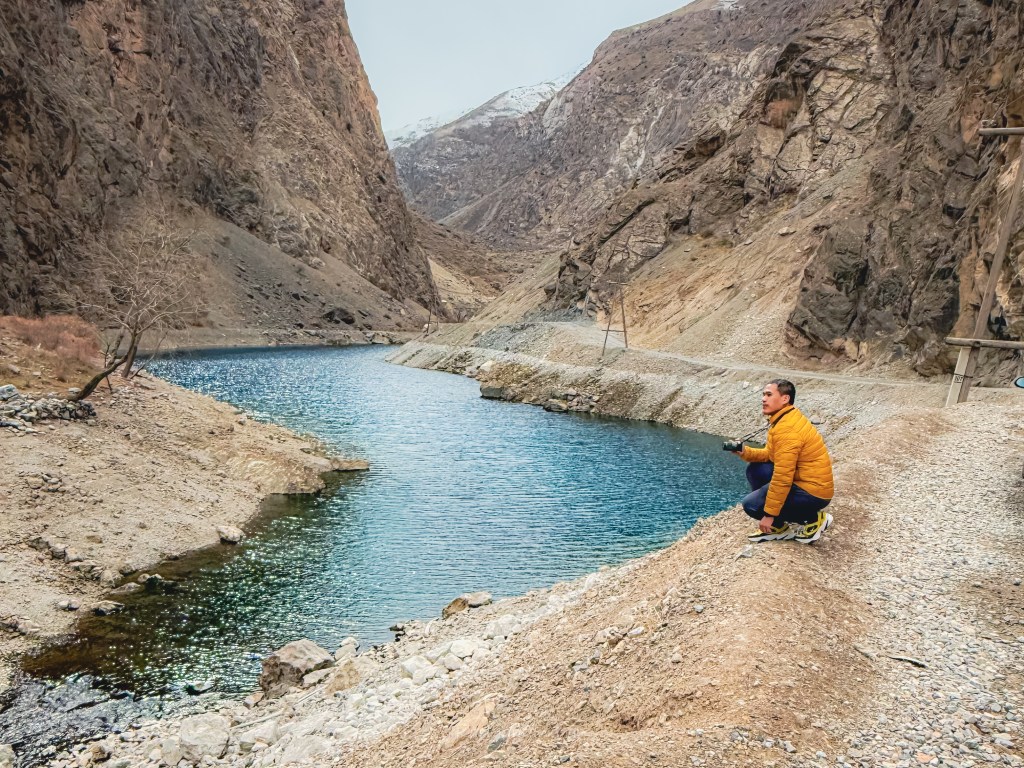
1. Nezhigon Lake
At 1,640 meters above sea level (masl), this is the first and lowest lake among the seven. Honestly, it may underwhelm at first (especially when your vehicle stops by for taking pictures), but once you see it from an elevated distance, you’d appreciate its beauty more.

2. Soya Lake (or Shadow Lake)
This lake is much larger than the Nezhigon Lake, and a big part of is shaded by rocky cliffs at the side. Its size can feel overwhelming, and honestly, my only complaint here is that it’s so hard to take a picture of the whole like in just one shot! Going here would only take several minutes from the first lake, as its elevation is not that high compared to Nezhigon Lake: 1,700 masl.

3. Gushor Lake
Now, this lake’s a lot more picturesque compared to the first two. At 1,770 masl, Gushor Lake is nestled among cliffs and has this distinct emerald water that matches its tranquil surroundings.
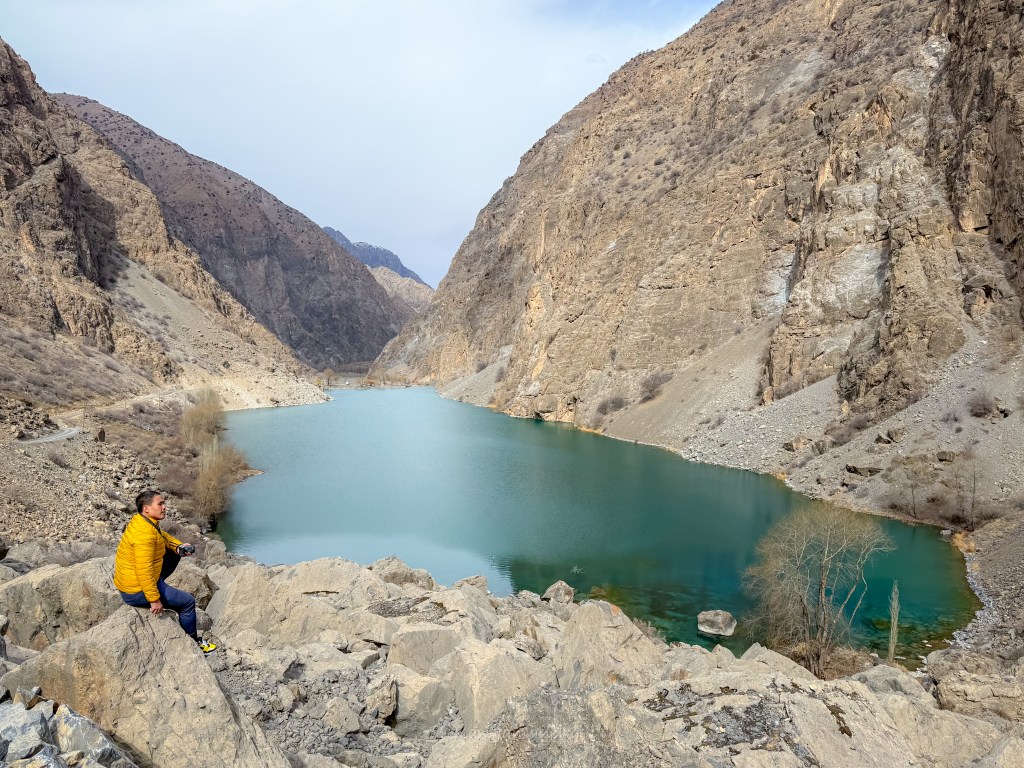
4. Nofin Lake
If you want to take your money shot here in Haftkul, you might consider taking a great pose here in Nofin Lake! Honestly, I immediately thought to myself that our trip to Tajikistan was worth it when I saw this lake. That’s how beautiful it is!
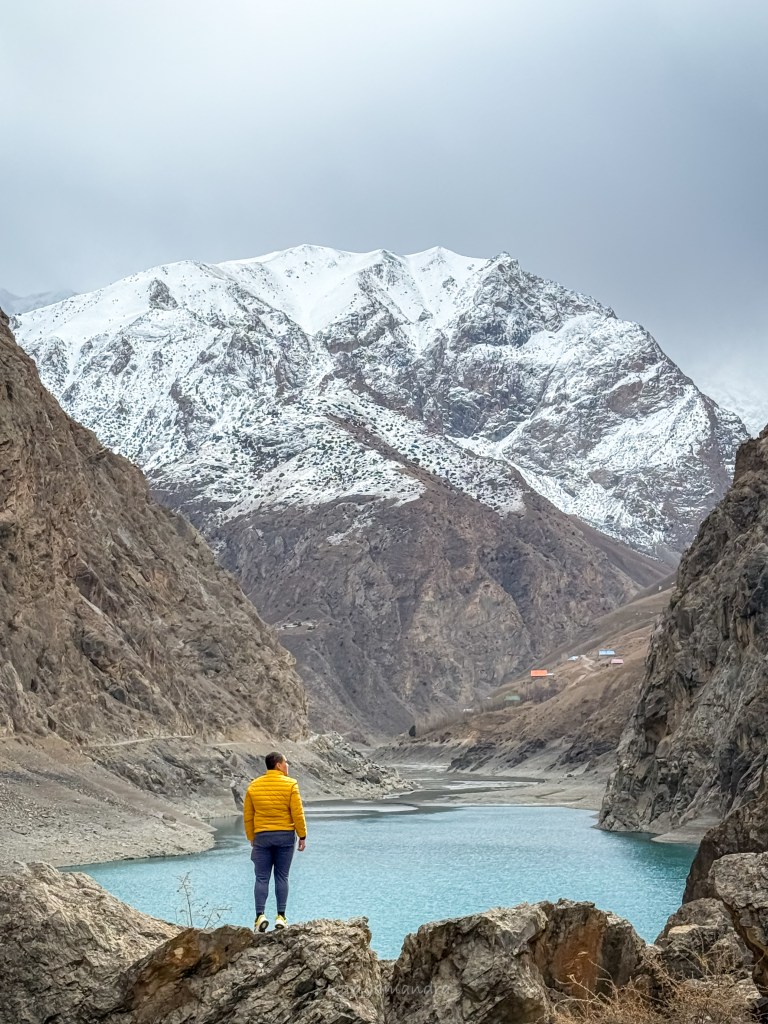
Moreover, a few villages can be seen near this lake. Even at its elevation of 1,820 masl, a lot of people still choose to reside here despite being far from the city. A few accommodations are also located here, which means tourists who intend to do overnight in Haftkul do it here. The owners of one of the accommodations here talked to us while we were taking pictures. They were very kind! They offered hot tea, as well as apples for snack. The owner’s name is Sir Jumaboy, and their accommodation is called Jumaboy Guesthouse. Should you intend to do an overnight along the Fann Mountains, you can contact them at their Facebook page, or at these numbers: +992-99-777-3362 and +992-1111-814-25.

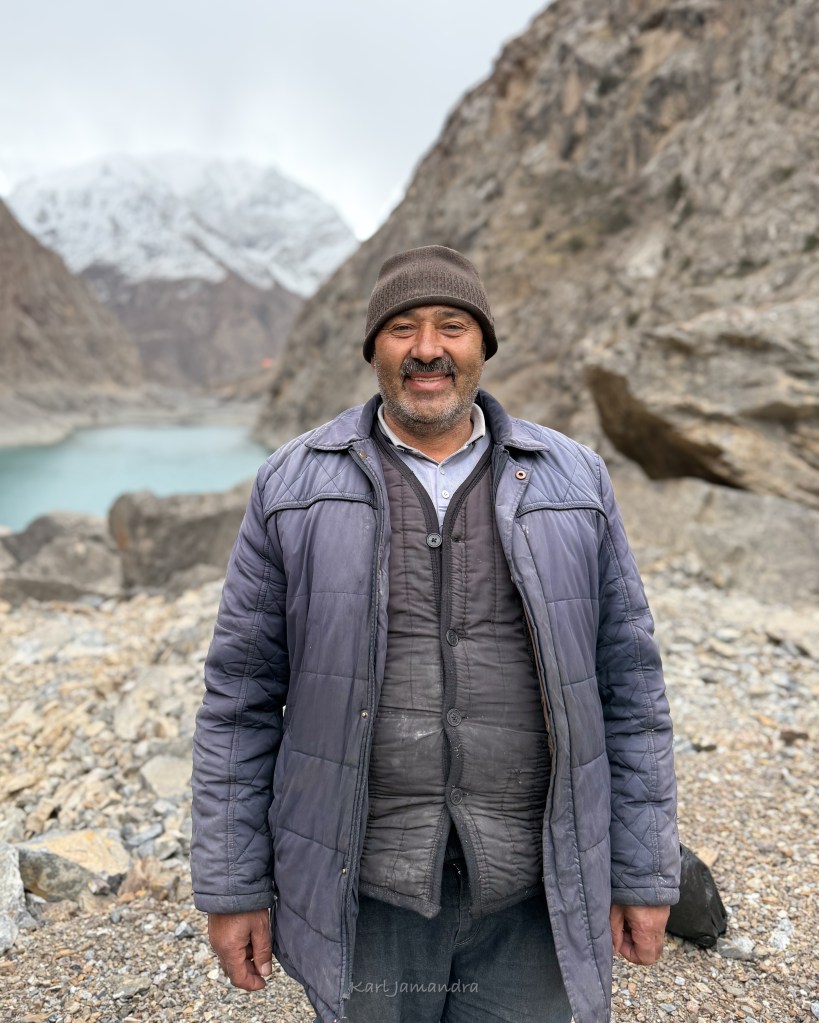
5. Khurdak Lake
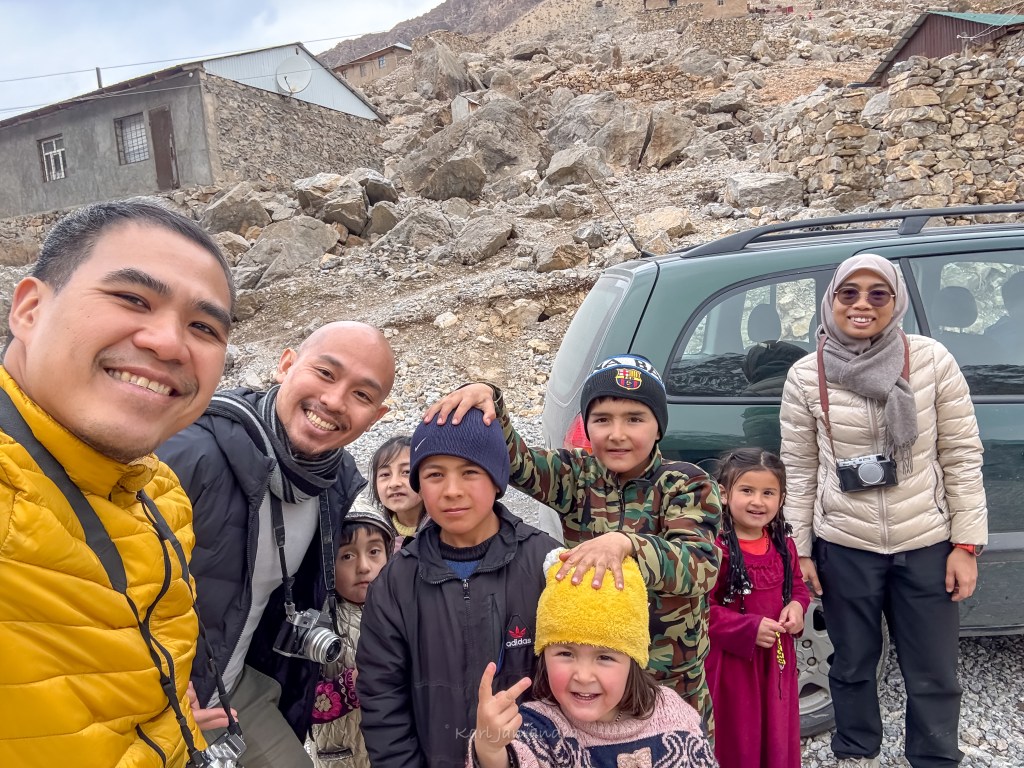
Considered to be the smallest lake among the seven, Khurdak Lake is surrounded by rocky cliffs that make for a beautiful landscape. At 1,870 masl, this lake is not that far from the fourth lake. Also, a village is located nearby, and when we were exploring the place, a lot of kids came rushing towards us. They were selling trinkets and the like, and if you want to help in your own little way, buy from them!

6. Marguzor Lake
Considered to be the centerpiece of Haftkul, Marguzor Lake is the largest lake among the seven. It’s considerably much higher, too, compared to the first five as it stands at 1,870 masl. We felt we were already at a really high elevation because of the very cool air we breathed when we were here.

I shouted with delight when I first saw its glacial waters surrounded by the pristine peaks of Fann Mountains! The water’s turquouise color was covered in some parts with whitish hints of ice. It was such a beauty! Just look at the picture above yourself!
As we were about to leave the lake, it rained with what felt like ice pellets. That’s how cold it was here.
7. Hazorchashma Lake
At 2,400 masl, Hazorchashma is the highest and last lake of the seven. It is said that it can be reached after about an hour of hiking. Some would say they could do it for 30 minutes, but I think it depends on the current weather condition along the Fann Mountains. I would have loved to reach this lake when we were there. Unfortunately, our guide discouraged us from going further after the sixth lake, as we would be going home late if we still pushed through. Maybe I’ll come back just to see it for myself? Anyway, it is said that the water in the lake comes from numerous springs. I would have liked to see that for myself!
Back at Panjakent
After a whole day tour of the Seven Lakes, we were famished! The only thing we were able to do in the city of Panjakent aside from taking pictures of the city was eat!
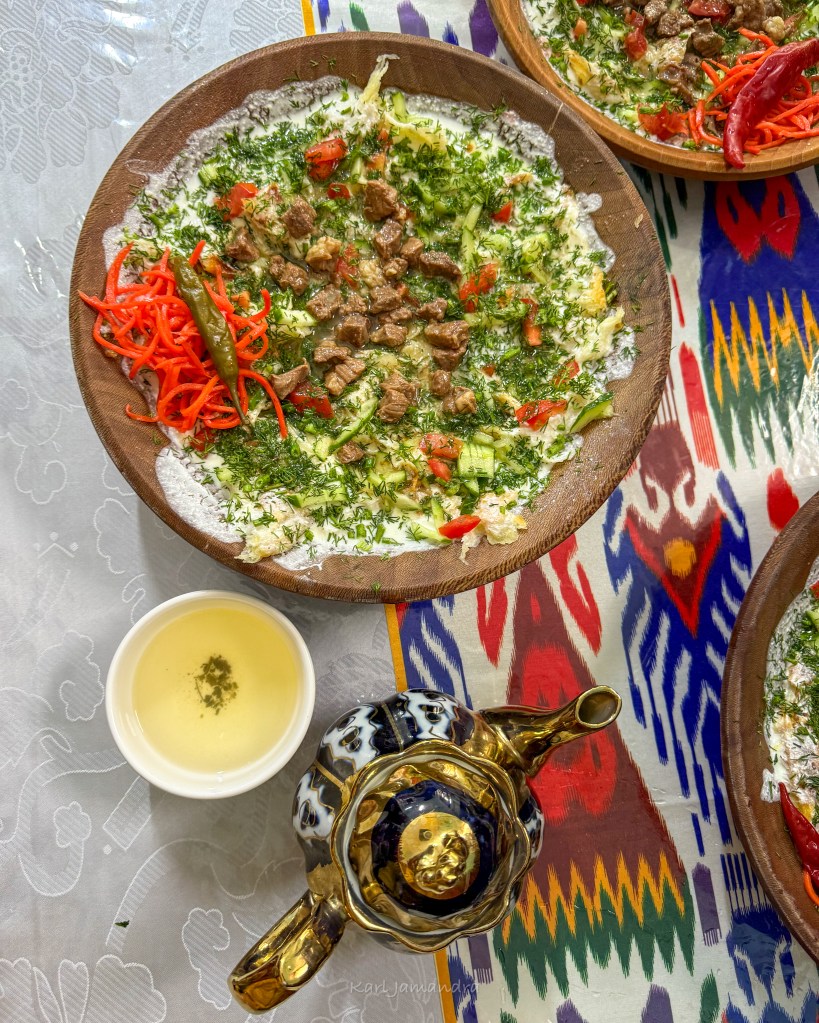
Qurotob is considered Tajikistan’s national dish. It is primarily made from pieces of flatbread called fatir, soaked in a sauce made from qurut (dried, salty cheese or yogurt balls). It is topped with sauteed onions, fresh herbs, tomatoes, cucumbers and meat.How’s the taste? It’s a mix of tangy, savory and sweet flavors of the ingredients. Definitely unique!
***
I hope I was able to convince you to visit Tajikistan, guys! Even for just a day, I was awed with this country because of the beauty of its seven lakes! Now, I wonder what else it has to offer. Maybe I’ll visit again in the future? Let’s see. As for you, start planning to visit this in your Central Asia trip!
P.S.
If you want a hassle-free travel in Central Asia, you can contact and avail the service of Offduty Bucketlist (ODBL). Its owner, Joey, is a good friend of mine, and I can tell you he can help you in all your travel needs. If you want to enjoy Tajikistan like I did, contact ODBL in their Facebook page and Instagram account now!
 K.O. the Explorer